Guides
4 parts of voiceover audience growth, explained
Voiceover audience growth rests on four parts including demo reel, audition pipeline, client retention and referral, and rights-clean delivery standards.
What to take away
- The four parts of voiceover audience growth are demo reel and genre positioning, audition pipeline, repeat-client and referral share, and rights-clean delivery. Nothing else belongs in the list.
- Each part has one numberreel-to-inquiry rate, audition-to-booking ratio, repeat-client share, and re-use requests per finished job.
- A reel is a booking tool, not a portfolio. Six to eight spots, one genre each, forty-five to ninety seconds total, hosted on a VoiceZam player, a Voices.com profile or your own site.
- Repeat clients cost nothing to reach. Track them separately from first-time inquiries so a slow month reads correctly.
- Rights language decides whether a job can be re-sold. Buyouts and work-for-hire change what you may reuse, so route the wording to an entertainment attorney.
This article covers voiceover business operations. It is not legal, tax, union or vocal-health advice.
Contract and buyout terms go to an entertainment or intellectual-property attorney in your jurisdiction. Tax positions and entity elections go to a CPA who works with Schedule C filers.
SAG-AFTRA eligibility and signatory questions go to the union's contracts department. Vocal strain or recovery questions go to an ENT or speech-language pathologist.
Most narrators treat audience growth as one job. It is four, and they fail in different ways. A narrator with a strong reel and a weak pipeline books twice and disappears. A narrator with a full pipeline and no repeat clients restarts from zero every quarter.
The four parts below are the whole list. If a task does not sit in one of them, it is a sub-step or it is admin.
Part one: the demo reel and genre position
The reel is the first thing a casting director hears and often the only thing. Its job is to place you in a genre before anyone reads your name.
Demo Reel Build Checklist
- Six to eight spots total
- One genre per spot
- Forty-five to ninety seconds total
- Lead with target genre
- Second spot proves range
- Pick three deliverable genres
Pick the three you can deliver on a deadline.
Host it where buyers already listen. A paid Voices.com or Voice123 membership puts demos on a searchable profile. VoiceZam sells a branded player on a monthly or annual subscription. SoundCloud is free, and your own site is the address you control.
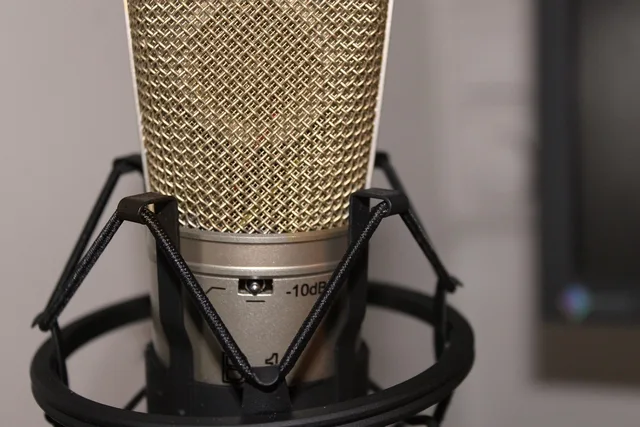
The chain behind the reel matters less than the writing, but it sets your floor. The Sennheiser MKH 416, typically about $1,000, is the mic most often named for commercial and promo work. The Neumann TLM 103, typically around $1,200, suits narration.
Cheaper options that still pass broadcast specs: the Rode NT1 at about $260, the Shure SM7B at about $400 and a Focusrite Scarlett 2i2 interface at about $200. Audacity is free, Reaper is $60 for a personal license, and Adobe Audition costs $22.99 a month.
Running order matters. Lead with the genre you want most work in, not the one you enjoy recording. The second spot should prove range without leaving the genre.
Measure it with the reel-to-inquiry rate: inquiries that name your reel divided by total inquiries, over one quarter. Near zero means the reel is the problem, not the marketing.
Part two: the audition pipeline
Auditions are a volume business with a quality floor. The number that matters is the audition-to-booking ratio, tracked per genre and per casting platform.
Where you send them sets your cost. Voice123 and Voices.com sell annual memberships that typically run $300 to $500, and each tier caps daily submissions.
Casting Call Club keeps a free tier with paid upgrades. Backstage charges a subscription, typically around $200 a year, and lists voice work beside on-camera calls. Fiverr and Upwork charge no listing fee and take roughly 20% and 10% of each order.
Audiobook work runs on different terms. ACX is free to join and pays 40% royalties on exclusive distribution and 25% on non-exclusive. Agents take 10% to 20%.
Audition Log Fields
- Date
- Source
- Genre
- Script length
- Whether you booked
- The fee
Google Sheets is free. Airtable and Notion have free tiers, and Streak adds a pipeline board inside Gmail. After sixty auditions you will see which source pays and which only fills your week.
Set a weekly audition target you can hit in an ordinary week, not a good one. Twenty is common for full-time narrators on pay-to-play platforms; pick your own and hold it for a month before judging it.
Two mistakes recur. Auditioning outside your three genres because the script is short. And re-recording an audition more than twice, which turns a fifteen-minute job into an hour.
Part three: repeat clients and referral share
This part costs nothing to reach and is the one most narrators never measure.
Repeat vs Referral Share
Repeat-client share
- Definition
- Clients who booked twice or more in 12 months
- Denominator
- Total clients
- Warning level
- Under a quarter
- Lever
- Pick-up note within a day
Referral share
- Definition
- First-time inquiries naming an existing client
- Denominator
- Total first-time inquiries
- Warning level
- Near zero
- Lever
- Same habit, slower
Track repeat-client share: clients who booked twice or more in the last twelve months, divided by total clients. Track referral share separately: first-time inquiries that name an existing client.
Both numbers move slowly. A repeat share under a quarter means every month starts at zero, and no amount of auditioning fixes that.
The lever is a short note after delivery asking whether anything in the file needs a pick-up, sent within a day. That habit turns a one-off e-learning job into a series. Keep the template in Gmail or Outlook so the note stays at four lines.
Repeat work clusters in a few places. ACX rights holders who produce series, e-learning vendors shipping quarterly modules, and agencies that keep a narrator on the roster. Airtable's free tier or a Google Sheet with a column for first booking and one for latest booking will surface them.
Invoicing belongs in this part too. Wave is free, FreshBooks runs about $19 a month, and QuickBooks Self-Employed sits near $20 a month.
Part four: rights-clean delivery
Delivery is where audience growth compounds or stops. A client who has to chase a file, a format or an invoice will not return, no matter how good the read was.
Rights language sits inside delivery. Work-for-hire and buyout clauses decide whether you may reuse a recording in your own reel or a future demo.
The U.S. Copyright Office's Copyright and the Music Marketplace report sets out how public performance and other uses can run through different rights and licensing paths.
The same logic applies to your own recordings: a session fee does not automatically buy every use.
Do not interpret or sign specific buyout or work-for-hire wording on your own. Send it to an entertainment or intellectual-property attorney in your jurisdiction.
Then measure it: re-use requests per finished job. A client who asks to extend a license is a client who is already growing your audience.
File specs are part of the same job. Send finals as 24-bit, 48 kHz WAV files unless the client asks for something else. Auditions go out as MP3 at 192 kbps.
ACX wants masters between -23 and -18 dBFS RMS with peaks below -3 dB. Dropbox and Google Drive handle large files, and WeTransfer's free tier caps a transfer at 2 GB.
For live directed sessions, Source-Connect and ipDTL are the paid standards and Cleanfeed has a free tier.
How the four parts fit together
| Part | One number | Review cadence |
|---|---|---|
| Demo reel and genre position: VoiceZam, Voices.com, Voice123 | Reel-to-inquiry rate | Twice a year |
| Audition pipeline: Voice123, Voices.com, Backstage, Casting Call Club | Audition-to-booking ratio | Monthly |
| Repeat clients and referral: Airtable, Google Sheets | Repeat-client share | Quarterly |
| Rights-clean delivery: Dropbox, WeTransfer, Source-Connect | Re-use requests per job | Per job |
The four parts feed each other in one direction. A reel that places you in a genre raises the booking rate on auditions in that genre. A higher booking rate produces more repeat clients. Repeat clients ask for license extensions, which is where the money sits.
Break the chain anywhere and the rest stalls. This is why a narrator who only auditions harder rarely moves.
A worked example of the arithmetic
Use your own figures. Let A be auditions per month, B the share that book, F the average fee, and R the share of clients who return within a year.
Monthly revenue from new work is A x B x F. Revenue from returning clients is roughly that figure multiplied by R, added on top. If A is 80, B is 0.05, and F is 300, new work is 1,200 a month. At R of 0.3, returning clients add about 360.
Now raise B from 0.05 to 0.08 by auditioning only inside your three genres. New work becomes 1,920. Nothing else changed. That is the whole argument for part one and part two working together.
Where the outside rules sit
Four sources set the boundaries, and none of them is a substitute for local advice.
The NIST Small Business Quick-Start Guides cover basic cybersecurity and privacy risk management for small organizations. Relevant if you hold client scripts, unreleased audio or personal data on your own drives.
The FTC's guide on soliciting and paying for online reviews says review requests should go to genuine clients without cherry-picking the happy ones. Testimonials on your site fall under this.
The FTC's Advertising FAQs cover truthful claims and disclosure of material connections. If a casting platform pays you to promote it, say so.
For the audience side of the work, how to grow a loyal voiceover audience in 2027 covers the community layer that sits on top of these four parts.
Common questions
Why exactly four parts and not more?
Because every other task is a sub-step of one of them. Booth upgrades, rate cards and invoicing all serve delivery. Marketing and social posting serve the reel or the pipeline. Four parts keep the review meeting short enough to actually happen.
Which part should a new narrator fix first?
The reel. A weak reel caps the booking rate no matter how many auditions you send. Record six spots in three genres, then run sixty auditions before changing anything else.
How long before the numbers mean something?
One quarter for the reel-to-inquiry rate and repeat-client share. One month for the audition-to-booking ratio, once you have sixty auditions logged. Anything shorter is noise.
What if a client asks for a full buyout?
Do not sign or interpret the wording yourself. Send it to an entertainment or intellectual-property attorney in your jurisdiction, and price the buyout against what the same recording would earn under a limited license.